Sunday, 26 February 2017

7 Earth-Size Planets Orbit Dwarf Star, NASA and European Astronomers Say


https://www.nytimes.com/2017/02/22/science/trappist-1-exoplanets-nasa.html?rref=collection%2Fsectioncollection%2Fscience&action=click&contentCollection=science&region=rank&module=package&version=highlights&contentPlacement=1&pgtype=sectionfront&_r=0

These new Earth-size planets orbit a dwarf star named Trappist-1 about 40 light years from Earth. Some of them could have water on their surfaces.


Not just one, but seven Earth-size planets that could potentially harbor life have been identified orbiting a tiny star not too far away, offering the first realistic opportunity to search for signs of alien life outside the solar system.

The planets orbit a dwarf star named Trappist-1, about 40 light-years, or 235 trillion miles, from Earth. That is quite close in cosmic terms, and by happy accident, the orientation of the orbits of the seven planets allows them to be studied in great detail.
One or more of the exoplanets in this new system could be at the right temperature to be awash in oceans of water, astronomers said, based on the distance of the planets from the dwarf star.

“This is the first time so many planets of this kind are found around the same star,” Michael Gillon, an astronomer at the University of Liege in Belgium and the leader of an international team that has been observing Trappist-1, said during a telephone news conference organized by the journal Nature, which published

Scientists could even discover compelling evidence of aliens.
“I think that we have made a crucial step toward finding if there is life out there,” said Amaury H. M. J. Triaud, an astronomer at the University of Cambridge in England and another member of the research team. “Here, if life managed to thrive and releases gases similar to that we have on Earth, then we will know.”
Cool red dwarfs are the most common type of star, so astronomers are likely to find more planetary systems like that around Trappist-1 in the coming years.

“You can just imagine how many worlds are out there that have a shot to becoming a habitable ecosystem,” Thomas Zurbuchen, associate administrator of NASA’s science mission directorate, said during a NASA news conference on Wednesday. “Are we alone out there? We’re making a step forward with this — a leap forward, in fact — towards answering that question.”
Telescopes on the ground now and the Hubble Space Telescope in orbit will be able to discern some of the molecules in the planetary atmospheres. The James Webb Space Telescope, scheduled to launch next year, will peer at the infrared wavelengths of light, ideal for studying Trappist-1.

Comparisons among the different conditions of the seven will also be revealing.
“The Trappist-1 planets make the search for life in the galaxy imminent,” said Sara Seager, an astronomer at the Massachusetts Institute of Technology who was not a member of the research team. “For the first time ever, we don’t have to speculate. We just have to wait and then make very careful observations and see what is in the atmospheres of the Trappist planets.”
Even if the planets all turn out to be lifeless, scientists will have learned more about what keeps life from flourishing.
Astronomers always knew other stars must have planets, but until a couple of decades ago, they had not been able to spot them. Now they have confirmed more than 3,400, according to the Open Exoplanet Catalog. (An exoplanet is a planet around a star other than the sun.)

The authors of the Nature paper include Didier Queloz, one of the astronomers who discovered in 1995 the first known exoplanet around a sunlike star.
While the Trappist planets are about the size of Earth — give or take 25 percent in diameter — the star is very different from our sun.
Trappist-1, named after a robotic telescope in the Atacama Desert of Chile that the astronomers initially used to study the star, is what astronomers call an “ultracool dwarf,” with only one-twelfth the mass of the sun and a surface temperature of 4,150 degrees Fahrenheit, much cooler than the 10,000 degrees radiating from the sun. Trappist is a shortening of Transiting Planets and Planetesimals Small Telescope.

During the NASA news conference, Dr. Gillon gave a simple analogy: If our sun were the size of a basketball, Trappist-1 would be a golf ball.
Until the last few years, scientists looking for life elsewhere in the galaxy have focused on finding Earth-size planets around sun-like stars. But it is hard to pick out the light of a planet from the glare of a bright star. Small dim dwarfs are much easier to study.
Last year, astronomers announced the discovery of an Earth-size planet around Proxima Centauri, the closest star at 4.24 light-years away. That discovery was made using a different technique that does not allow for study of the atmosphere.

Trappist-1 is about 8 percent the size of the sun. Credit ESO
Trappist-1 periodically dimmed noticeably, indicating that a planet might be passing in front of the star, blocking part of the light. From the shape of the dips, the astronomers calculate the size of the planet.
Trappist-1’s light dipped so many times that the astronomers concluded, in research reported last year, that there were at least three planets around the star. Telescopes from around the world then also observed Trappist-1, as did the Spitzer Space Telescope of NASA.

Spitzer observed Trappist-1 nearly around the clock for 20 days, capturing 34 transits. Together with the ground observations, it let the scientists calculate not three planets, but seven. The planets are too small and too close to the star to be photographed directly.
All seven are very close to the dwarf star, circling more quickly than the planets in our solar system. The innermost completes an orbit in just 1.5 days. The farthest one completes an orbit in about 20 days. That makes the planetary system more like the moons of Jupiter than a larger planetary system like our solar system.
“They form a very compact system,” Dr. Gillon said, “the planets being pulled close to each other and very close to the star.”
In addition, the orbital periods of the inner six suggest that the planets formed farther away from the star and then were all gradually pulled inward, Dr. Gillon said.
Because the planets are so close to a cool star, their surfaces could be at the right temperatures to have water flow, considered one of the essential ingredients for life.

The fourth, fifth and sixth planets orbit in the star’s “habitable zone,” where the planets could sport oceans. So far that is just speculation, but by measuring which wavelengths of light are blocked by the planet, scientists will be able to figure out what gases float in the atmospheres of the seven planets.
So far, they have confirmed for the two innermost planets that they are not enveloped in hydrogen. That means they are rocky like Earth, ruling out the possibility that they were mini-Neptune gas planets that are prevalent around many other stars.
Because the planets are so close to Trappist-1, they have quite likely become “gravitationally locked” to the star, always with one side of the planets facing the star, much as it is always the same side of Earth’s moon facing Earth. That would mean one side would be warmer, but an atmosphere would distribute heat, and the scientists said that would not be an insurmountable obstacle for life.

For a person standing on one of the planets, it would be a dim environment, with perhaps only about one two-hundredth the light that we see from the sun on Earth, Dr. Triaud said. (That would still be brighter than the moon at night.) The star would be far bigger. On Trappist-1f, the fifth planet, the star would be three times as wide as the sun seen from Earth.
As for the color of the star, “we had a debate about that,” Dr. Triaud said.
Some of the scientists expected a deep red, but with most of the star’s light emitted at infrared wavelengths and out of view of human eyes, perhaps a person would “see something more salmon-y,” Dr. Triaud said.
NASA released a poster illustrating what the sky of the fourth planet might look like.

If observations reveal oxygen in a planet’s atmosphere, that could point to photosynthesis of plants — although not conclusively. But oxygen together with methane, ozone and carbon dioxide, particularly in certain proportions, “would tell us that there is life with 99 percent confidence,” Dr. Gillon said.
Astronomers expect that a few decades of technological advances are needed before similar observations can be made of Earthlike planets around larger, brighter sunlike stars.
Dr. Triaud said that if there is life around Trappist-1, “then it’s good we didn’t wait too long.”

“If there isn’t, then we have learned something quite deep about where life can emerge,” he continued.
The discovery might also mean that scientists who have been searching for radio signals from alien civilizations might also have been searching in the wrong places if most habitable planets orbit dwarfs, which live far longer than larger stars like the sun.

The SETI Institute in Mountain View, Calif., is using the Allen Telescope Array, a group of 42 radio dishes in California, to scrutinize 20,000 red dwarfs. “This result is kind of a justification for that project,” said Seth Shostak, an astronomer at the institute.
“If you’re looking for complex biology — intelligent aliens that might take a long time to evolve from pond scum — older could be better,” Dr. Shostak said. “It seems a good bet that the majority of clever beings populating the universe look up to see a dim, reddish sun hanging in their sky. And at least they wouldn’t have to worry about sun block.”
 
Correction: February 22, 2017
An earlier version of this article named the wrong telescope that is trained on the Trappist-1 dwarf star. It is the Spitzer Space Telescope, not the Kepler. The article also misstated how many days it takes for the planet farthest from Trappist-1 to orbit the star. It is about 20 days, not 12.35.

Attack on Khadiza: Sylhet court to hold hearing Mar 1

Attack on Khadiza: Sylhet court to hold hearing Mar 1

A Sylhet court today fixed March 1 for the arguments in the case filed over the hacking of college student Khadiza Begum Nargis.
Judge Saifuzzaman Hiru of Chief Metropolitan Magistrate Court fixed the date after completing hearing on charge framing, reports a correspondent from Sylhet.

On October 3 last year, Khadiza Begum Nargis, a student of Sylhet Government Women's College, was brutally hacked by Badrul Alam, a student of Shahjalal University of Science and Technology and senior assistant secretary of the Bangladesh Chhatra League unit at the institute.

READ ALSO: Outrage all around
A total of 32 witnesses out of 33 gave deposition before a Sylhet court, said Mahfuzur Rahman, additional public prosecutor of Sylhet court.

Around 10:38am, the court started it proceeding with the presence of the victim Khadiza and the accused Badrul, said the PP.

READ MORE: Khadiza returns home
Badrul Alam confessed before the court saying that he was not in the normal state during the incident, said his lawyer Sazzadur Rahman Choudhury.

On November 15, 2016, Additional Chief Metropolitan Magistrate of the district Umme Sharaban Tahura accepted the charge sheet that police pressed accusing Badrul on November 8.

ALSO READ: Khadiza fighting for life, survival chances slim
On October 5, 2016, Badrul Alam confessed to hacking Khadiza in his statement he made under section 164 of the Code of Criminal Procedure (CrPC).

On the incident day, after Khadia was hacked severely by Badrul, she was first taken to Sylhet Osmani Medical College Hospital from where she was moved to Dhaka.

After being treated at hospitals in Dhaka and Savar for more than four months, Khadiza Begum Nargis returned home on February 24.

Tuesday, 7 February 2017

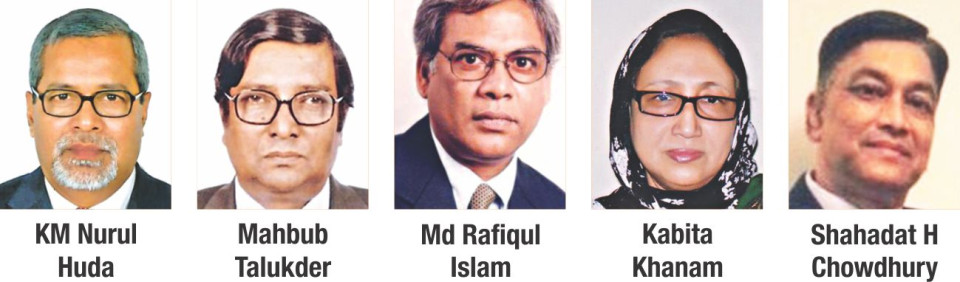
Ex-secy Nurul Huda new CEC

Ex-secy Nurul Huda new CEC

President also appoints four election commissioners including one woman

Former secretary KM Nurul Huda has been chosen to lead the next Election Commission.

President Abdul Hamid appointed him chief election commissioner last night in line with a constitutional provision, according to a gazette notification issued around 10:00pm.
The president also appointed four election commissioners who include one woman for the first time. They are Mahbub Talukder, former additional secretary; Md Rafiqul Islam, ex-secretary; Begum Kabita Khanam, former district and sessions judge; and Brig Gen (retd) Shahadat Hossain Chowdhury.

The oath-taking ceremony of the new EC would take place today or tomorrow, said sources at the Bangabhaban.
In his immediate reaction, the newly appointed CEC said, "I am grateful to the president for appointing me to this important constitutional position. I will try my best to carry out the responsibility impartially in line with the constitution."
Nurul Huda, a freedom fighter, told The Daily Star that he would devise a work strategy for the commission after consulting his colleagues.
"We will sit with the political parties because they are the most important stakeholders," he said, seeking cooperation from all political parties, civil society members as well as other stakeholders in performing his duties.

Earlier, Cabinet Secretary Shafiul Alam said Nurul Huda's name was not there in the proposals of the ruling Awami League and the BNP, submitted to the six-member search committee for constituting the next EC.
Of the commissioners, Mahbub's name was suggested by the BNP while Kabita's name was proposed by the AL, he told reporters at the Cabinet Division.

In the evening, the search panel met the president at the Bangabhaban, and proposed the names of Nurul Huda and ex-cabinet secretary Ali Imam Majumder for the CEC post.
Majumder was also recommended for the job in 2012 but the then president didn't pick him.

Born in 1948 in Patuakhali's Baufal, Nurul Huda completed his schooling in Patuakhali. He obtained his graduation and master's in Statistics from Dhaka University.

He also studied Public Administration and Advanced Studies at the University of Manchester, and pursued further studies in the then Soviet Union, he said.
Nurul Huda joined the 1971 Liberation War in Sector-9.

Sunday, 18 September 2016

People suffer in Paturia, Daulatdia tailbacks

People suffer in Paturia, Daulatdia tailbacks

Star Online Report


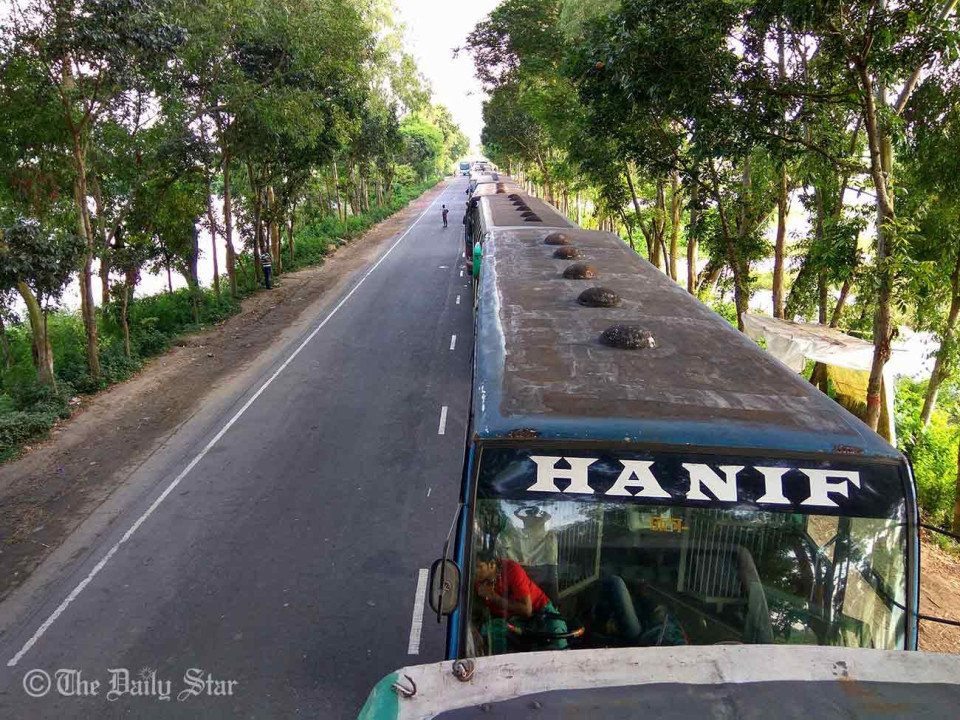
Passenger busses remain stuck in a tailback at Paturia ferry terminal on Sunday, September 18, 2016. Photo: Palash Khan Thousands of people have been suffering on both ends of Paturia and Daulatdia ferry terminals due to a tailback.

Ferry services at the terminals were hampered triggering a two-kilometre tailback as the number of landing stations at Daulatdia end was decreased due to river erosion.

Passengers of 21 south and south-western districts travelling to and fro have been facing serious problems including shortages food and toilet facilities at the ferry terminals.
Paturia ferry terminal
Passenger busses remain stuck in a tailback at Paturia ferry terminal on Sunday, September 18, 2016. 
Two of the four landing stations of the Two of the four landing stations of the Daulatdia terminal are in operation, our Manikganj correspondent reports quoting Md Shafiqul Islam, manager (commerce) of Bangladesh Inland Water Transport Corporation (BIWTC) at Daulatdia ferry terminal.

The landing station no. 4 was closed at around 1:00am today as its approach road of Rajbari Roads and High ways damaged by the river erosion, he said.

The landing station no. 2 was suspended earlier due to the damage by the erosion, the BIWTC official added.

Abdus Sattar, manager (Marine), of Bangladesh Inland Water Transport Corporation (BIWTC) at Aricha office, said 13 of 19 ferries are in operation as six are being repaired.

Around five hundred vehicles were seen stranded at Daulatdia terminal under Goalunda upazila in Rajbari district today.

On the other end, a two-kilometre tailback was created at Paturia ferry terminal under Shivalaya upazila in Manikganj where Shyamal, a youth of Faridpur, said he was waiting for ferry at Paturia terminal for nearly three hours.

A driver of Eagle Paribahan said his vehicle was stranded at Paturia terminal for more than two and a half hour.

Powerful Blast Injures at Least 29 in Manhattan; Second Device Found

A powerful explosion caused by what the authorities believe was a homemade bomb injured at least 29 people on a crowded sidewalk in the bustling Chelsea neighborhood of Manhattan on Saturday night.

A few hours later, the authorities found and removed what they described as a second explosive device four blocks away, raising the possibility that two bombs had been planted in the heart of the city.


http://goforworldbd.blogspot.com/
Mayor Bill de Blasio called the explosion — which occurred about 8:30 p.m. on West 23rd Street — “an intentional act” but initially said there was no connection to terrorism and no immediate claim of responsibility.

Police officers swarmed Chelsea’s streets after the blast, which reverberated across a city scarred by terrorism and vigilant about threats, just days after the 15th anniversary of the Sept. 11 attacks.
“Whatever the cause,” Mr. de Blasio said, “New Yorkers will not be intimidated.”

As the authorities sought to identify what had caused the explosion, they described the second device as a pressure cooker resembling the one used in the deadly Boston Marathon bombings in 2013, according to a police official, who spoke on the condition of anonymity to discuss a continuing investigation.
It was unclear whether the blast on West 23rd Street had been caused by the same type of explosive.

In the immediate aftermath, the police shut down a swath of Manhattan south of Midtown. The area from 14th Street to 32nd Street was closed to traffic between Fifth and Eighth Avenues. But by 7 a.m., only 23rd Street remained closed.
A grim Mr. de Blasio, speaking at a news conference at the scene around 11:15 p.m., said “injuries are significant.” But for the moment, he said, none of them were life-threatening.

Many of the injuries were caused by shrapnel from the explosion, which witnesses said seemed to have started inside a sidewalk Dumpster near the Avenue of the Americas. Images of a twisted Dumpster in the middle of West 23rd Street quickly proliferated on Twitter.

Witnesses said the blast on West 23rd Street had seemed to come from a Dumpster. The authorities were investigating the cause. 
The impact shattered windows, damaged cars and sent crowds running from the scene at an hour when Chelsea, always a popular destination, was filled with residents and tourists.
“It was the biggest blast I ever would imagine, lights flashing, glass shattering,” said a woman who was injured in the explosion.
The force of the explosion, she said, flung her into the air.
“It happened so fast I was thrown up and landed down, I didn’t know where it had come from,” said the woman, who would give only her first name, Helena, as she hobbled out of Bellevue Hospital Center about 4 a.m. after she was treated for injuries to her eye and legs. “I realized there was blood streaming down my face, and I couldn’t see out of my eye.”

Luke McConnell, who was visiting from Colorado, was headed toward a restaurant on West 27th Street when the blast occurred. “I felt it, like a concussive wave, heading towards me.”
“Then there was a cloud of white smoke that came from the left side of 23rd Street near Sixth,” he said. “There was no fire, just smoke.”

Witnesses said they could feel the explosion from several blocks away. Daniel Yount, 34, said he was standing on the roof of a building at 25th Street and the Avenue of the Americas with friends.
“We felt the shock waves go through our bodies,” he said.
It was a startling scene, full of dark possibilities, for a city that endured the attacks of Sept. 11, 2001, but has so far been spared the kind of mayhem that has terrorized city after city around the world in the 15 years since.

The closest New York has come to an attack was in 2010, when the police found a crude car bomb of propane, gasoline and fireworks inside a sport utility vehicle in Times Square. Although the device had apparently started to detonate, there was no explosion.
On Saturday night in Chelsea, the device found on West 27th Street also caused no harm.

Images shared on social media and confirmed as authentic by a senior police official showed a silver-colored piece of cookware with wires and a cellphone attached.
The official said the Police Department’s bomb squad was taking the device to a department facility in the Bronx, where robots would inspect it.

A Police Department truck, which was towing the second explosive device in a spherical chamber, drove away with it around 2:25 a.m. Sunday. 
Around 2:25 a.m., a Police Department truck towing a spherical chamber, which contained the device, headed east on West 27th Street and turned up the Avenue of the Americas. Several police officers who had spent the evening on alert were visibly relieved, as one by one they let the few residents who had been waiting all night beside the caution tape return home.
It was a cool Saturday night, and the businesses along West 23rd Street, the busiest east-west thoroughfare in Chelsea, were teeming with customers.
The blast seemed to shake the entire block, smashing windows in a five-story brownstone building and sending debris into the street, a law enforcement official said.
The sidewalk where the explosion occurred is in front of a nondescript building wedged between a church and an apartment building.
Video captured before the explosion shows a man crossing “the street in the direction of where the device was found,” the same official said. But no video had yet been obtained clearly showing anyone placing the device in the spot where it detonated.
“We don’t understand the target or the significance of it,” the police official said. “It’s by a pile of Dumpsters on a random sidewalk.”
Marcello Begu, 58, was spinning pizzas at the nearby Ciao Bella Napoli restaurant when he heard the blast.
“I’ve never heard a noise like that in my life,” he said. “The ground was shaking. I was scared to go outside.”
In Washington, the White House issued a brief statement saying that President Obama had been briefed on the developing situation in New York.
Both the Democratic and Republican presidential candidates broke from their campaign routines to address the issue.
Donald J. Trump, in Colorado Springs, rushed to describe the explosion as a bomb well before the authorities had made any determinations about what had happened and while the situation was still in flux.
“I must tell you that just before I got off the plane, a bomb went off in New York and nobody knows exactly what’s going on,” he said. “But boy, we are living in a time — we better get very tough, folks.”
The Democratic nominee, Hillary Clinton, was informed of the episode after she gave a speech at the Congressional Black Caucus Foundation’s annual awards dinner, her campaign said.
She seemed to scold Mr. Trump for his quick assessment.
“I think it’s always wiser to wait until you have information before making conclusions,” Mrs. Clinton said.
Officials said the New York explosion was not connected to a blast that happened 11 hours before when an improvised device exploded in a garbage can near the course of a charity race that was about to start in a small town on the Jersey Shore. That device went off around 9:30 a.m. near the boardwalk in Seaside Park, N.J., according to the Ocean County sheriff, Michael G. Mastronardy.
There were no injuries. The race, the Seaside Semper Five, a five-kilometer run and charity event along the waterfront that raises money for members of the United States Marine Corps and their families, was canceled.

Saturday, 9 July 2016

Nisha Biswal to arrive Dhaka tomorrow

Nisha Biswal to arrive Dhaka tomorrow

US Assistant Secretary of State for South and Central Asian Affairs Nisha Desai Biswal will arrive in Dhaka tomorrow for a two-day official visit in the wake of terrorist attack at a Gulshan café in Dhaka on July 1 that left 22 people including 17 foreigners and two police officers dead.

During her visit to Dhaka, Biswas will meet with the high government officials including the home minister and foreign minister.

She may also call on Prime Minister Sheikh Hasina, diplomatic sources in Dhaka and Washington said.
Biswal will discuss the security situation in Bangladesh following the July 1 attack, US offer for support in investigation into the attack, security for US embassy officials and US facilities in Bangladesh.

She visited Dhaka on May 5 and 6 after the brutal murder of USAID staff Xulhaz Mannan in Dhaka on April 25.
Twenty hostages were brutally murdered during the chilling siege on July 1 before the commandoes stormed the popular hangout in Dhaka's diplomatic zone next morning.
Nine Italians, seven Japanese, two Bangladeshis, one Bangladeshi-American and one Indian were killed among others.

To policemen were also killed on the day of the attack at Holey Artisan Bakery in Gulshan.

Thirteen hostages were rescued while six of the gunmen, who attacked the upscale eatery on Road 79 Friday night, were killed in the 50-minute army-led joint forces operation codenamed "Operation Thunderbolt".
The seventh attacker was held in the operation beginning at 7:40am, officials said.

Shootings Further Divide a Nation Torn Over Race

Shootings Further Divide a Nation Torn Over Race

A spray-painted mural on a building on Foster Drive in Baton Rouge, La., on Thursday, where Alton Sterling was shot to death by a police officer two days earlier.
First came the cellphone video of an African-American man being fatally shot by a Louisiana police officer, and the astonishing live feed of a Minnesota woman narrating the police killing of her African-American boyfriend during a traffic stop. Then came the horrific live television coverage of police officers being gunned down by a sniper at a march protesting the police shootings.
And suddenly, the panoply of fears and resentments that have made this a foreboding summer had been brought into sharp relief.

Police accountability and racial bias have been at the center of the civic debate since August 2014, when a black teenager was killed by a white officer in Ferguson, Mo., a suburb of St. Louis. Mass murders in Newtown, Conn.; Charleston, S.C.; Orlando, Fla., and too many other locales have revived gun violence as a social issue and national shame. Both black anger at police killings and the boiling frustrations of some whites who feel they are ceding their long-held place in society have been constant undercurrents in politics since January and the Iowa presidential caucuses.

Now, in the space of three days, the killings of two black men by Louisiana and Minnesota police officers and the retaliatory murders of five Dallas officers, this time by a black Army veteran, have coalesced all those concerns into a single expression of national angst. In the midst of one of the most consequential presidential campaigns in memory, those convulsive events raised the prospect of still deeper divides in a country already torn by racial and ideological animus.

Since the Thursday night sniper attack the national conversation has swung between bitterness and despair over seemingly unbridgeable gulfs in society. The New York Post’s front page blared “CIVIL WAR.” The Drudge Report warned in a headline that “Black Lives Kill.” Some Minnesota protesters on Thursday night chanted, “Kill the police.”

Police officers and sociologists alike say that racial tension is approaching a point last seen during the street riots that swept urban American in the late 1960s when disturbances erupted in places like the Los Angeles neighborhood of Watts and Detroit and Newark, during summers of deep discontent.

“Even in the 1960s and 1970s, when there was a lot of tension around policing and civil rights and the antiwar movement, we’d never seen anything like what happened in Dallas,” said Darrel W. Stephens, the executive director of the Major Cities Chiefs Association and an instructor at the Public Safety Leadership Program in the School of Education at Johns Hopkins University.

Mr. Stephens and other police officials said that departments were increasingly schooling officers in ways to avoid and defuse violent encounters with minorities. But other experts said the parade of cellphone videos depicting shootings of black men have only reinforced African-Americans’ conviction that little has changed in six decades.

“There is a constant bombardment of images of brutality against African-Americans, and not just brutality, but state-sponsored brutality,” said Paul Butler, a former federal prosecutor and a law professor at Georgetown University Law Center. This week’s videos, he said, were particularly devastating. “It’s visceral,” he said. “It hits you in the gut. It’s emotional and graphic, so it makes you feel worse.”

There are some parallels today to the 1960s. Those riots were largely touched off by violent encounters between blacks and the police. Scholars say and statistics show that attacks on police officers became an increasingly frequent African-American response to decades of inequality and mistreatment at that time.
The Kerner Commission, established by President Lyndon B. Johnson, reported in 1968 that “Our nation is moving toward two societies, one black, one white — separate but unequal.” And a white backlash became a driving force in the presidential campaign that year that saw a tough-talking Republican, Richard M. Nixon, end eight years of Democratic rule.
Whether this week’s violence presages a repeat of that history is, of course, an unknown, as the nation’s first black president nears the end of two terms in office and the two political parties move toward their national conventions this month.

But racial tensions are clearly rising. A June survey by the Pew Research Center found that only 46 percent of whites surveyed thought that race relations were generally good, a sharp drop from the 66 percent who held that opinion in June 2009, shortly after Mr. Obama took office. For blacks, the corresponding decline — to 34 percent last month from 59 percent in 2009 — was even steeper.
The same Pew survey found that about three-quarters of African-Americans thought that blacks in their communities were treated less fairly by the police than were whites; a bare 35 percent of whites felt the same.

In the hours after the Dallas ambush, stunned officials and civic leaders pleaded for citizens to repair the rips in the nation’s social fabric.

“Our profession is hurting,” said the Dallas police chief, David O. Brown, who is African-American. “Dallas officers are hurting. We are heartbroken. There are no words to describe the atrocity that occurred to our city. All I know is that this must stop, this divisiveness between our police and our citizens.”

The Rev. Bryan Carter echoed him at a Friday memorial service for the fallen officers, saying: “We refuse to hate each other. We commit to pray together.”
 

President Obama, speaking on Friday from Warsaw, where he was attending a two-day NATO summit meeting, said of the police, “Today is a wrenching reminder of the sacrifices they make for us.” He called the attack a “vicious, calculated and despicable attack on law enforcement.”

In a presidential race in which racial and ethnic divisions have become an issue, both Hillary Clinton and Donald J. Trump canceled political events on Friday. Mr. Trump called the events in Texas “an attack on our country.”
“It is a coordinated, premeditated assault on the men and women who keep us safe,” Mr. Trump said in a statement. “We must restore law and order.”

Mrs. Clinton wrote on Twitter on Friday, “I mourn for the officers shot while doing their sacred duty to protect peaceful protesters, for their families and all who serve with them.”
But on social media, there were salutes to the sniper, blame of the news media for dividing the nation, charges that black protesters had spread hysteria, calls for love, fear of civil war and laments that the country is headed toward an unbridgeable divide.

সুরা কাহফ: ঢাল ও আলোকবর্তিকা

আল্লাহ তায়ালা মুসলিমদের জন্য বিভিন্নভাবে বিশেষ নেয়ামত ও ফজিলত দান করেছেন। কখনো বিশেষ কোনো দিনকে, কখনো কোনো সময়কে, কখনো কোনো আমলকে এবং কখনো ক...