

Saudi Arabia could drastically limit numbers at the annual hajj pilgrimage to prevent a further outbreak of coronavirus after cases in the country topped 100,000, sources familiar with the matter said on Monday. Some 2.5 million pilgrims visit the holiest sites of Islam in Mecca and Medina for the week-long hajj, an once-in-a-lifetime duty for every able-bodied Muslim who can afford it. Official data show hajj and the lesser, year-round umrah pilgrimage earn the kingdom about $12 billion a year. Saudi Arabia asked Muslims in March to put hajj plans on hold and suspended umrah until further notice. Two sources familiar with the matter said authorities are now considering allowing "only symbolic numbers" this year, with restrictions including a ban on older pilgrims and additional health checks. With strict procedures, authorities think it may be possible to allow in up to 20 per cent of each country's regular quota of pilgrims, another source familiar with the matter told Reuters. Some officials are still pushing for a cancellation of the hajj, expected to start in late July, the three sources said. The government media office and a spokesman for the hajj and umrah ministry did not respond to requests for comment. Limiting or cancelling hajj will further pressure government finances hit by the plunge in oil prices and the pandemic. Analysts predict a severe economic contraction this year. The kingdom halted international passenger flights in March, and on Friday it reimposed a curfew in Jeddah, where hajj flights land, after a spike in infections in the city. In 2019, around 19 million pilgrims attended umrah while hajj drew 2.6 million. An economic reform plan of Crown Prince Mohammed bin Salman aims to increase umrah and hajj capacity to 30 million pilgrims annually and generate 50 billion riyals ($13.32 billion) of revenues by 2030.($1 = 3.7530 riyals)

Wednesday, 24 June 2020
Tuesday, 23 June 2020
Saudi considers limiting hajj pilgrims amid COVID-19 fears
Saudi considers limiting hajj pilgrims amid COVID-19 fears
Monday, 22 June 2020
One killed, 11 injured in shooting at the epicentre of US anti-racism protests
One killed, 11 injured in shooting at the epicenter of US anti-racism protests

One person was killed and 11 were injured in a shooting in the early hours of Sunday in Minneapolis, police said.
"One adult male died and 11 have no-life-threatening wounds," Minneapolis police tweeted, adding in a separate tweet that people who suffered gunshot wounds had been taken to area hospitals. The city has been at the heart of a wave of anti-racism protests in the United States and around the world over the death of George Floyd, a Black man who died in Minneapolis police custody last month. There was no indication that Saturday's shooting was related to this. As of 4:00am, no one was in custody in connection with the shooting, the Associated Press reported.
General holiday announced for red zones in 10 districts
General holiday announced for red zones in 10 districts
Police guard the entrance to East Rajabazar in Dhaka as the area was marked as red zone due to intense coronavirus infection on 10 June 2020

The government on Sunday announced general holidays in some areas that were marked as red zone by the health authorities in 10 districts, due to high coronavirus infection risk, reports UNB.
The districts are Chattogram, Bogura, Moulvibazar, Chuadanga, Jashore, Madaripur, Narayanganj, Habiganj, Munshiganj and Cumilla.
The public administration ministry issued a gazette notification in this regard, saying the announcement will come into effect from Sunday.The notification stated the decision was taken to control public movement strictly considering the risk of infection in the areas. The holidays will be effective only in the red zones.
All job-holders of any sector residing in the red zones will enjoy the holidays. In Chattogram, Uttar Kattali area of ward no. 10 (except the BSCIC industrial area) under Chattogram city corporation will be under the purview of the announcement. Here, the holidays will continue until 8 July.The holidays will be effective in Chelopara, Nataipara, Naruli, Jaleswaritala, Sutrapur, Maltinagar, Thanthania, Haripari and Colony areas of Bogura until 5 July.
In Chuadanga, wards 5 and 7 of Darshana municipality of Damurhuda upazila will be under the announcement until 8 July.
General holidays will be effective in some areas of Sreemangal sadar, Baramchal, Kadipur unions and Kulaura municipality of Moulvibazar until 5 July.Besides, the holiday will be effective for some areas of Rupganj sadar union in Narayanganj until 2 July.
In Habiganj, ward 6 and 9 of Habiganj municipality, Deorgach, Ubahata, Ranigaon and sadar municipality of Chunarughat, Ajmiriganj sadar union and Madhabpur municipality area will be under the holidays until 9 July.
The holidays will be effective for Mathpara area of ward no. 1 in Munshiganj municipality until 9 July.
Residents of areas falling under wards 3, 10, 12 and 13 of Cumilla city corporation will enjoy the holiday till 3 July.
Vast areas of Jashore and Madaripur will also face the red zones’ strict lockdown until different dates.
Saturday, 28 March 2020
No new COVID-19 patient detected in Bangladesh in last 24 hours: IEDCR
No new COVID-19 patient detected in Bangladesh in last 24 hours: IEDCR
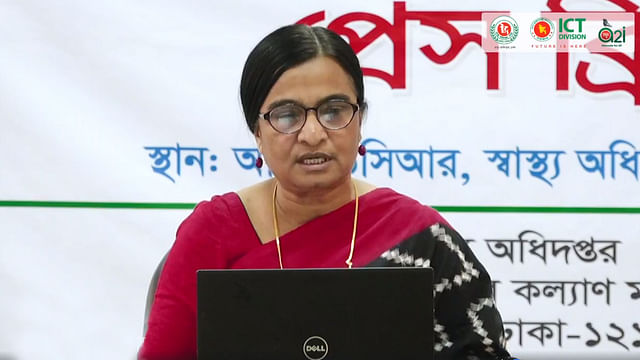
IEDCR direcotr professor Meerjady Sabrina Flora
No
one has been diagnosed with COVID-19 in Bangladesh in the last 24
hours, said the Institute of Epidemiology, Disease Control and Research
(IEDCR) on Saturday.
No patient died of the deadly virus in the
last 24 hours while four infected patients recovered, said Institute of
Epidemiology, Disease Control and Research (IEDCR) director professor
Meerjady Sabrina Flora at an online media briefing, reports UNB.
The death toll from novel coronavirus (COVID-19) reached 27,359 globally on Saturday morning.
It has so far infected 597,185 people around the world, according to worldometers.info.
It has so far infected 597,185 people around the world, according to worldometers.info.
Of the infected, 436,466 are currently undergoing treatment while 23,523 of them are in critical condition.
So far, 160,719 cases had outcomes. Of them, 133,360 (83 per cent) recovered and 17 per cent died.
So far, 160,719 cases had outcomes. Of them, 133,360 (83 per cent) recovered and 17 per cent died.
Over 600,000 Cases Worldwide; $2 Trillion Aid Bill Enters Law
Over 600,000 Cases Worldwide; $2 Trillion Aid Bill Enters Law

President Trump signed into law the largest economic stimulus package in modern American history and said the government would buy thousands of ventilators. The virus’s death toll has surged in Spain and Italy.
Earlier this week, the country surpassed the case totals in China and
Italy. The number of known cases has risen rapidly in recent days, as
testing ramped up after weeks of widespread shortages and delays. Over
600,000 cases have now been confirmed worldwide, according to figures
compiled by Johns Hopkins University.
On Friday, President Trump signed into law a $2 trillion measure
designed to respond to the coronavirus pandemic. In the largest
economic stimulus package in modern American history, the government
will deliver direct payments and jobless benefits for individuals, money
for states and a huge bailout fund for businesses battered by the
crisis.
Mr.
Trump signed the measure in the Oval Office hours after the House
approved it by voice vote, and less than two days after the Senate
unanimously passed it. Mr. Trump thanked “Democrats and Republicans for
coming together and putting America first.”
The
legislation will send direct payments of $1,200 to millions of
Americans, including those earning up to $75,000, and an additional $500
per child. It will substantially expand jobless aid, providing an
additional 13 weeks and a four-month enhancement of benefits, and for
the first time will extend the payments to freelancers and gig workers.
The
measure will also offer $377 billion in federally guaranteed loans to
small businesses and establish a $500 billion government lending program
for distressed companies reeling from the crisis. It will also send
$100 billion to hospitals.
Faced with a
torrent of criticism from cities and states that have been pleading for
help to deal with the most critically ill coronavirus victims, Mr. Trump
also announced on Friday that the federal government would buy thousands of ventilators
from a variety of makers, though it appeared doubtful they could be
produced in time to help hospitals that are now overwhelmed.
Also on Friday, the Trump administration cut off tens of millions of dollars for health care programs and other aid in Yemen,
rejecting pleas by humanitarian groups and some members of Congress to
delay the decision as the country’s packed refugee camps prepare to face
the pandemic.
American officials said
the move was a necessary response to longstanding interference by
Houthi rebels who control the northern part of Yemen, and who have
imposed harsh restrictions on organizations trying to deliver aid.
Mayor
Bill de Blasio of New York warned at a news conference that officials
would decide this weekend whether to impose a $500 fine on residents
flouting social-distancing rules during the coronavirus outbreak by
gathering in large groups at parks and ignoring police orders to
disperse.
The vast majority of New
Yorkers have been respecting the rules, the mayor said, but officials
have observed some violations in the past day.
Mr. de Blasio
also said that a few houses of worship were continuing to hold religious
services and that they risked fines or having their buildings
permanently closed if the police found congregations in them this
weekend.
Officials said late Friday
that the number of coronavirus cases in New York City had climbed above
26,000. The city’s death toll was 450.
In
New Rochelle, N.Y., meanwhile, the state’s drastic measures to contain a
cluster of coronavirus cases may be starting to work, according to the
latest data for Westchester County.
Spain and Italy,
the two countries with the world’s largest coronavirus death tolls, have
each recorded a grim new daily record: 832 dead in the past 24 hours in
Spain, bringing the total to 5,690 on Saturday; 969 in the most recent
figures in Italy, for a total of 9,134.
As of Saturday, 12,248 people were reported to have recovered from the virus in Spain, about double the number of victims.
“A lot remains to be done, but the figures bit by bit indicate that we
are reaching this peak,” said Fernando Simón, the director of Spain’s
national health emergency center.
The
spike in deaths was particularly shocking in Italy, where until
Friday’s figures were released deaths appeared to have been slowing.
But
both countries have seen recent falls in the number of confirmed new
infections, though that figure rose again slightly in Spain on Saturday.
Dr. Simón told a news conference on Friday that it was good news that
the pace of recovery was accelerating significantly.
Hopes
were more muted in Italy, where the head of the national health
institute, Silvio Brusaferro, suggested the outbreak “could peak in the
next few days.”
Even so, he said, “We can’t delude ourselves that a slowing down of the diffusion will allow us to slow down social distancing.”
Franco
Locatelli, the president of Italy’s Higher Health Council, a government
advisory board, said that while there were “clear signs” that the
restrictive measures enacted three weeks ago were working, it was
important that they be maintained. Should they be loosened, “all the
work we’ve done until now will have been for nothing,” he said.
As countries throughout Europe grappled with a shortage of protective
equipment for health workers, Spain received four million masks
delivered from China on Saturday, delivered by an Airbus aircraft,
according to the company. The shortage has been particularly acute in
Spain, where health workers represent 15 percent of confirmed cases.
As the
coronavirus pandemic rages on, experts have started to question official
guidance about whether ordinary, healthy people should protect
themselves with a regular surgical mask, or even a scarf.
The
World Health Organization and the Centers for Disease Control and
Prevention continue to state that masks don’t necessarily protect
healthy individuals from getting infected as they go about their daily
lives.
The official guidance continues
to recommend that masks be reserved for people who are already sick, as
well as for the health workers and caregivers who must interact with
infected individuals on a regular basis. Everyone else, they say, should
stick to frequent hand-washing and maintaining a distance of at least
six feet from other people to protect themselves.
But
the recent surge in infections in the United States, which has put the
country at the center of the epidemic, means that more Americans are now
at risk of getting sick. And healthy individuals, especially those with
essential jobs who cannot avoid public transportation or close
interaction with others, may need to start wearing masks more regularly.
While wearing a
mask may not necessarily prevent healthy people from getting sick, and
certainly doesn’t replace important measures such as hand-washing or
social distancing, it may be better than nothing, said Dr. Robert Atmar,
an infectious disease specialist at Baylor College of Medicine.
But
studies of influenza pandemics have shown that when high-grade N95
masks are not available, surgical masks do protect people a bit more than not wearing masks at all. And when masks are combined with hand hygiene, they help reduce the transmission of infections.
Singapore and Hong Kong, which kept their infection numbers low
in the first weeks of the outbreak, have stepped up measures to enforce
social distancing in public, as imported cases continue to drive the
spread in both places.
Through the end of April, anyone in
Singapore who fails to maintain a one-meter distance from others while
standing in line, or while sitting in a chair that isn’t attached to the
floor, can be jailed for up to six months, fined up to $7,000 or both,
the Ministry of Health said. Proprietors of cinemas and other places with fixed seating are required to ensure that people don’t sit next to each other.
In
Hong Kong, public gatherings of more than four people will be banned
for two weeks starting Sunday, with some exceptions, including funerals.
Wedding ceremonies will be limited to 20 people. Restaurants must be no
more than half-full, and cinemas, fitness centers and other recreations
sites will be temporarily closed.
Hong Kong’s chief executive, Carrie Lam,
who announced the new restrictions on Friday, backed off from an earlier
plan to ban the sale of alcohol in bars and restaurants, after the
industry pushed back against it. Like Singapore’s new restrictions, Hong
Kong’s are punishable by fines and jail terms of up to six months.
Hong
Kong reported 65 new coronavirus cases on Friday, its largest
single-day total yet, bringing its total past 500. Singapore reported 49
new cases. Many of the new cases in both cities involved people who had
recently returned from abroad.
“For weeks now it
has been evening,” Pope Francis said Friday on the steps of St. Peter’s
Basilica. “Thick darkness has gathered over our squares, our streets
and our cities; it has taken over our lives.”
The
pope spoke alone, before a vast and empty square, its rain-slicked
cobblestones reflecting the blue lights of the police locking down Rome.
“We find ourselves afraid,” he said. “And lost.”
A
new anxiety has seized Vatican City, which has about 600 citizens and a
population of about 246 people behind the Vatican walls. About 100 of
the residents are young Swiss Guards, but the others include the pope, a
handful of older cardinals, the people who work in their households,
and some laymen, making it in some ways as vulnerable as a nursing home
to a virus that can be devastating to the old.
This
week, the Vatican confirmed cases of the coronavirus inside its walls,
and on Wednesday reports emerged that an official who lives in the
pope’s residence had tested positive and required hospitalization. Now
the Vatican, which has also essentially canceled all public
participation in Easter ceremonies, is testing scores of people and
considering isolating measures for the 83-year-old pope, who had part of
a lung removed during an illness in his youth.
Top Vatican officials said Francis has had negative results to two
separate tests and has said privately he doesn’t have the virus.
Ireland became
the latest European country living under tight movement restrictions on
Saturday, imposing a lockdown nearly a week later than its harder-hit neighbor, Britain, but with conditions that were in some respects stricter.
“Freedom
was hard-won in our country, and it jars with us to restrict and limit
individual liberties, even temporarily,” Prime Minister Leo Varadkar
said in an address on Friday. He described the new rules as “restricting
our lives so that others might live.”
As of early Saturday, Ireland had reported 2,121 confirmed cases of the coronavirus, and 22 deaths.
From midnight until at least Easter Sunday, Irish people are being ordered to stay home
except to travel to essential jobs, medical appointments, family care
or “brief” exercise within 2 kilometers — about a mile and a quarter —
of home. All but a few shops are shut, and public transport is
restricted to essential workers.
The
exercise restrictions attracted particular interest in Britain, after a
series of public controversies over what was appropriate under lockdown.
Several London boroughs have closed local parks and play areas; one of London’s largest parks has temporarily banned cyclists; and the police in Derbyshire, England, have published drone footage of people parking cars and walking in the Peak District, a popular national park, labeled “This Is Not Essential Travel.”
On Saturday, the British government published new guidance to exercise “near your home where possible.”
Britain
is also converting large convention centers in Birmingham and
Manchester into coronavirus hospitals, the head of its National Health
Service said on Saturday, a measure it has already taken in London.
Prime Minister
Shinzo Abe of Japan warned on Saturday that the country was at risk of
an explosion of coronavirus infections, but announced no specific new
measures to control the spread.
“At
this point, we are not going to declare a state of emergency, but we are
barely holding on,” Mr. Abe said at a news conference Saturday evening
in Tokyo. “And we believe that we are still on the brink.”
The Japanese leader, who last week asked the International Olympic Committee to delay the Tokyo summer Olympics by one year
because of the coronavirus pandemic, said the government would draft a
supplementary budget with economic measures “of a scale that would
exceed those after the Lehman crisis.” It would include cash payouts to
households and small firms.
Although
Japan has not been put on a full lockdown, many businesses have suffered
as large sports and cultural events have been canceled and tourism has
all but collapsed.
Mr. Abe said that Japan’s current policy in dealing with the coronavirus was to “identify early chains of infections in so-called clusters.”
But
he acknowledged that if “an explosive spread of infections breaks out,”
particularly in big cities like Tokyo or Osaka, that strategy would
“collapse immediately.”
Tokyo has
recorded double-digit increases in cases for the past three days. Last
week, Tokyo’s governor, Yuriko Koike, asked residents not to venture
outside this weekend unless it was essential
On Saturday, the governor of Chiba announced 57 new cases — 31 workers and 26 visitors — at a welfare facility for the disabled.
Here is how some other countries are responding to the virus:
- Poland’s Parliament passed a law early on Saturday allowing voting by mail for older citizens and those in quarantine or self-isolating. Opposition parties have called for presidential elections, scheduled in May, to be postponed.
- Turkey halted all intercity trains and limited domestic flights on Saturday. Its number of coronavirus cases jumped by a third in a day to 5,698, with 92 dead.
- Australia stepped up enforcement of social distancing rules on Saturday. It also closed more beaches and threatened fines if people defy pleas to stay at home. The country’s number of confirmed cases rose by 469 to 3,635 on Saturday, the federal health ministry said, from fewer than 100 earlier this March.
- Brazil’s president, Jair Bolsonaro, continues to cast doubt on São Paulo’s death toll from the outbreak, accusing the state governor, without evidence, of manipulating the numbers for political ends. “I’m sorry, some people will die, they will die, that’s life,” Mr. Bolsonaro said in a television interview Friday night. He said that in São Paulo State, Brazil’s economic powerhouse — which has the most cases and deaths so far of coronavirus in Brazil, at 1,223 cases and 68 death — the death toll seemed “too large.”
In some respects, a pandemic is an equalizer: It can afflict princes
and paupers alike, and no one who hopes to stay healthy is exempt from
the strictures of social distancing. But the American response to the
virus is laying bare class divides that are often camouflaged — in
access to health care, child care, education, living space, even
internet bandwidth.
In New York,
well-off city dwellers have abandoned cramped apartments for spacious
second homes. In Texas, the rich are shelling out hundreds of thousands
of dollars to build safe rooms and bunkers.
And
across the country, there is a creeping consciousness that despite talk
of national unity, not everyone is equal in times of emergency.
“This
is a white-collar quarantine,” said Howard Barbanel, a Miami-based
entrepreneur who owns a wine company. “Average working people are
bagging and delivering goods, driving trucks, working for local
government.”
Some of those catering to
the well-off stress that they are trying to be good citizens. Mr.
Michelson emphasized that he had obtained coronavirus tests only for
patients who met guidelines issued by the Centers for Disease Control
and Prevention, rather than the so-called worried well.
Still,
a kind of pandemic caste system is rapidly developing: the rich holed
up in vacation properties; the middle class marooned at home with
restless children; the working class on the front lines of the economy,
stretched to the limit by the demands of work and parenting, if there is
even work to be had.
For
the millions of Americans who found themselves without a job in recent
weeks, the sharp and painful change brought a profound sense of
disorientation. They were going about their lives, bartending, cleaning,
managing events, waiting tables, loading luggage and teaching yoga. And
then suddenly they were in free fall, grabbing at any financial help
they could find, which in many states this week remained locked away
behind crashing websites and overloaded phone lines.
In
17 interviews with people in eight states, Americans who lost their
jobs said they were in shock and struggling to grasp the magnitude of
the economy’s shutdown, an attempt to slow the spread of the virus.
Unlike the last economic earthquake, the financial crisis of 2008, this
time there was no getting back out there to look for work, not when
people were being told to stay inside. What is more, the layoffs
affected not just them, but their spouses, their parents, their siblings
and their roommates — even their bosses.
“I
don’t think anyone expected it to be like this,” said Mark Kasanic, 48,
a server at a brasserie in Cleveland who was one of roughly 300 workers
that a locally owned restaurant company laid off last week. Now he is
home schooling his children, ages 5 and 7, one with special needs.
Julian
Bruell was one of those who had to deliver the bad news to hourly
employees like Mr. Kasanic. Mr. Bruell, 30, who helps run the company
with his father, said that only about 30 employees were left running
takeout and delivery at two of its five restaurants. He has not been
earning a salary, his goal being to keep the business afloat through the
crisis.
On Thursday, he was planning to file for unemployment himself.
For months,
President Trump has downplayed the severity of the pandemic, overstated
the impact of his policies and potential treatments, blamed others and
tried to rewrite the history of his response.
Hours
after the United States became the nation with the most reported
coronavirus cases on Thursday, Mr. Trump appeared on Fox News and
expressed doubt about shortages of medical supplies, boasted about the
country’s testing capacity, and criticized his predecessor’s response to
an earlier outbreak of a different disease.
“I
don’t believe you need 40,000 or 30,000 ventilators,” he said, alluding
to a request by Gov. Andrew Cuomo of New York. The president made the
statement in spite of government reports about potential shortages — and he reversed course on Friday morning, calling for urgent steps to produce more ventilators.
Speaking
on Fox on Thursday, Mr. Trump suggested wrongly that because of his
early travel restrictions on China, “a lot of the people decided to go
to Italy instead” — though Italy had issued a more wide-ranging ban on travel
from China, earlier than the United States. And at a White House
briefing on Friday, he wrongly said he was the “first one” to impose
restrictions on China.
He misleadingly
claimed again on Friday that “we’ve tested now more than anybody.” In
terms of raw numbers, the United States has tested more people for the
coronavirus than Italy and South Korea, but it lags behind in tests per capita.
And
he continued to falsely claim that the Obama administration “acted
very, very late” during the H1N1 epidemic in 2009 and 2010.
To
stay resilient in frightening times, it’s critical to remember that
gleams of hope do exist. “Whenever I’ve asked people what thing they’re
most proud of in their lives, it’s always connected to times of pain or
strife or struggle and how they got through it,” said Jeremy Ortman, a
mental health counselor in New York.
So what bright spots are there to keep in mind during this pandemic?
Kindness is in the news. Maybe people are being better to each other, or maybe we’re just noticing it more. People are serenading each other across windowsills. Animal shelters are reporting upticks in foster applications. Volunteers are buying groceries for their neighbors.
Research is moving at breakneck speed. Doctors are scrambling to improve testing and find anti-viral treatments.
The mobilization in the medical field recalls organizing efforts during
World War II, said Robert Citino, executive director of the Institute
for the Study of War and Democracy at the National World War II Museum
in New Orleans.
“I don’t think there
has ever been more human ingenuity devoted to a single scientific
problem than the one we’re facing right now,” he said.
We could be learning crucial lessons.
Years from now, if a deadlier virus emerges, we may find that today’s
innovations and procedures have prepared us for it. “What we’re facing
is unprecedented, and I don’t want to downplay its seriousness, but it’s
not the worst-case scenario,” said Malia Jones, a researcher who
studies infectious diseases at the University of Wisconsin in Madison.
“I
hope the takeaway here is that we’ll be better prepared to deal with
the next pandemic,” Dr. Jones said. “This is a good practice run for a
novel influenza pandemic. That’s the real scary scenario.”
Spain counts 832 deaths in 24 hours
Spain counts 832 deaths in 24 hours
 http://goforworldbd.blogspot.com/
The death toll from coronavirus in Spain surged over 5,600 on Saturday after a record 832 people died in 24 hours, and the number of infections soared over 72,000, the government said.
Spain has the world's second-highest coronavirus death toll after Italy with 5,690 fatalities. The number of confirmed cases has jumped to 72,248 as the country moves to significantly increase testing.
Although Spain's latest figures showed a daily increase of more than 8,000 cases, the rate of new infections appears to be slowing, with officials saying the epidemic appeared to be nearing its peak.
Madrid remains the worst-hit region, with 2,757 deaths and 21,520 infections, leaving hospitals and mortuaries overwhelmed, and the regional authorities working to open a second temporary morgue in an unused public building near the airport to house the dead.
An initial site was opened last week at the ice skating rink at the Palacio de Hielo (Ice Palace) shopping centre.
With undertakers also overwhelmed, the government has authorised the army's involvement in the collection and transport of bodies for the duration of the state of emergency.
The latest figures came as Spain marked two weeks since the imposition of an unprecedented national lockdown which will remain in place until at least 11 April.
Earlier on Saturday, Spain received a delivery of 1.2 million masks from China for health workers and those in the transport sector, the government said.
The delivery, which arrived at Madrid's Barajas airport, includes some 387,000 surgical masks for healthcare personnel, 75,000 masks for the security forces and more than 725,000 for those in the transport sector, from bus drivers to port and airport staff as well as those working for the postal service.
Subscribe to:
Posts (Atom)
চুক্তি না হলে রোববারই ইরানে হামলা হতে পারে: ট্রাম্প
ইরানে আবারো সামরিক হামলা চালানোর কথা বিবেচনা করছেন যুক্তরাষ্ট্রের প্রেসিডেন্ট ডোনাল্ড ট্রাম্প। শনিবার তিনি বলেছেন, ওয়াশিংটন ‘আগামীকালই’ ইরান...

-
F.B.I. Opened Inquiry Into Whether Trump Was Secretly Working on Behalf of Russia Following President Trump’s firing of James B. Com...
-
Fired Officer Is Indicted in Breonna Taylor Case; Protesters Wanted Stronger Charges A former officer was charged with “wanton endangermen...
-
আল-আকসা ভেঙে থার্ড টেম্পল নির্মাণের প্রচারণায় ইসরায়েল ফিলিস্তিনের মু...


